
Staying With What Is: The Healing Power of the Long Night
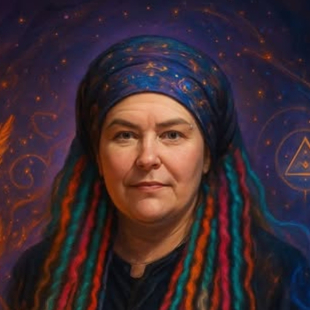
There is a reason so many ancient cultures marked the longest night of the year.
They did not experience darkness as failure.
They did not interpret it as punishment, regression, or lack of faith.
They experienced it as a threshold—a liminal passage where something essential could happen, but only if it was not rushed.
In a world without artificial light, the longest night was unmistakable. It was felt in the body, in the animals, in the land itself. People learned to listen to that slowing. They learned to respond not with fear, but with gathering.
In Persian tradition, Shab-e Yalda invites families to stay awake together through the longest night of the year.
They eat pomegranates

—fruits filled with many seeds, symbols of life continuing underground, unseen but intact. They read poetry—because poetry speaks where certainty cannot. They tell stories—because memory becomes shelter when the future is unclear. And most importantly, they do not rush the night away.
They stay.
This matters more than we often realize.
Because staying awake together is not about vigilance or endurance.
It is about companionship.
It is about refusing to abandon one another when answers are unavailable.
It is about choosing presence over reassurance.
It is about letting the night be the night—without trying to redeem it.
Modern healing culture, by contrast, often prioritizes solutions over presence. Fixing over feeling. Progress over process. We are taught to move through discomfort quickly, to extract meaning immediately, to turn pain into insight before the body has had time to metabolize it.
But the nervous system does not heal through pressure.
It heals through safety.
And safety is not created by answers.
It is created when we are not abandoned in our uncertainty.
Psychologically, this is called co-regulation—the way nervous systems settle in the presence of another regulated, attuned being. Somatically, it is the body finally exhaling because it does not have to brace itself alone. Spiritually, it is faith without performance—the kind that does not require certainty to remain intact.
The long night teaches us something essential:
Love does not require clarity to stay.
There are moments when answers are unavailable. When insight has not yet arrived. When the future feels unformed, and any attempt to define it feels premature. These moments can be deeply uncomfortable, especially in cultures that prize decisiveness and forward motion.
The instinct to rush through them—to bypass them with meaning, optimism, or motivation—is understandable. It is often born of care. But it can also be born of discomfort with not-knowing.
And when we rush, we often delay healing rather than accelerate it.
Winter is not a mistake in the cycle.
It is a necessary phase of integration.
In nature, nothing blooms all year. Growth requires dormancy. Expansion requires contraction. Even the heart rests between beats.
Yet many of us have been conditioned to treat stillness as stagnation, grief as something to overcome, and waiting as failure. We internalize the belief that if nothing visible is happening, nothing valuable is happening.
But this is not how life works.
At Kavi Apoha, we understand transformation as something that happens with the body, not against it. And bodies understand rhythm. They understand cycles. They understand when it is time to turn inward.

The body knows when it is winter.
If you find yourself in a season of waiting, grieving, or not-knowing, you are not stuck. You are incubating.
Incubation does not look impressive. It often looks quiet. It may look like withdrawal, reduced energy, or a loss of certainty. But beneath the surface, essential reorganization is taking place.
This is not regression.
This is preparation.
There is profound healing in allowing the night to be the night.
In letting grief be what it is without trying to redeem it.
In letting sadness exist without asking it to teach you something immediately.
In letting uncertainty remain without forcing it into resolution.
When we stop demanding that pain justify itself, something softens.
When we stop insisting that every dark season produce insight on command, the body relaxes. It trusts that it will be listened to rather than overridden.
Trust, like healing, cannot be forced.
It grows when it is not rushed.
The long night is not asking you to understand it.
It is asking you to stay.
To stay with your breath.
To stay with your body.
To stay with what is true, even if it is incomplete.
And crucially, it asks you not to do this alone.
Shab-e Yalda was never meant to be a solitary vigil. It was communal by design. Stories were shared. Food was passed. Presence was collective.
Healing has always been relational.
We are not meant to navigate uncertainty in isolation. We are not meant to metabolize grief alone. We are not meant to carry the weight of not-knowing without witnesses.
If you are in a long night right now, let this be said plainly:
You are not late.
You are not behind.
You are not failing the process.
You are exactly where the cycle has brought you.
And you do not have to walk through it alone.
There is wisdom in waiting.
There is courage in staying.
There is love in keeping company with what has not yet resolved.
The night will not last forever.
But it will last long enough to do its work—if we let it.


Comments